Why LED Grow Lights Can Catch Fire
The failure chain in a grow light almost always starts in one of four places.
The driver
The driver is the power supply that converts wall voltage into the low, constant current the diodes need. The driver is one of the most important components to evaluate in a grow light because it handles the conversion and regulation of incoming power.
Inside the driver are electrolytic capacitors, and they are temperature-sensitive by design. Higher-quality drivers may use 105°C-rated electrolytic capacitors and incorporate protections such as over-temperature, over-voltage, over-current, and short-circuit protection. Lower-cost designs may use lower-rated components or provide fewer protection features, which can increase failure risk under sustained heat and load.
This is why the driver brand is worth as much attention on a spec sheet as the wattage. A named driver tells you the manufacturer didn't hide the most failure-prone component. VIVOSUN's AeroLight A100, for example, pair Samsung 301B diodes — the kind of component-level disclosure that separates a fixture built for years of daily use from one built to a price.
The wiring
Short circuits, bare or pinched wires, cords cut too short, and connections left exposed to moisture turn otherwise-sound fixtures into hazards. Most of these are installation problems, not manufacturing defects.
Circuit overload
A grow light is a continuous load — it runs for 12 to 18 hours at a stretch. Pulling too much wattage through a single circuit, or through an old or undersized outlet, is a genuine fire risk regardless of how well the light itself is made.
Overheating
Most of the electrical power consumed by an LED grow light ultimately becomes heat that must be dissipated.
A proper heat sink — a large, finned aluminum extrusion — pulls heat away from the diode junction and dumps it into the air. In poorly controlled LED circuits, excessive heat can contribute to thermal runaway, where rising temperature can increase current and create further heating. Proper constant-current regulation and thermal management help prevent this condition.
It's one reason a passive-cooled fixture is a good thing: a light with a large heat sink and no fan has no fan to seize or clog while you aren't looking, which removes an entire unattended failure mode.
How to Prevent Grow Light Fires
Electrical certification
UL and ETL are electrical-safety listings — they mean an independent lab tested the fixture for fire and shock risk. DLC, by contrast, is a performance and efficiency listing, not a safety one. For U.S. buyers, look for a recognized electrical safety certification such as UL or ETL. The certification should apply to the specific product/model rather than simply appearing as a generic mark in a product listing.
Circuit capacity
For continuous loads, electrical circuits are generally designed with additional capacity rather than being operated continuously at their full rated load. In the U.S., the commonly cited 80% figure comes from the way continuous loads are accounted for under electrical code, but the exact requirements depend on the installation. If you're unsure about your circuit capacity, consult a qualified electrician.
Heat management
The fixture is rarely the problem — the room is. Give the heat sink a few inches of clearance, mount the driver in a dry, ventilated spot (many growers mount it outside the tent entirely), and make sure warm air isn't recirculating around the light. Ventilation is fire prevention, not just plant care: an inline exhaust fan that pulls hot, humid air out of the space is non-negotiable for anything running 12-plus hours a day.
Installation
Mount the light securely, keep the cord from being pinched, and route cables so they can't be snagged or stepped on. The majority of "installation" fires are really wiring fires — an unprotected connection, a cord forced through a wall, or a plug run at its limit.
Are LED Grow Lights Waterproof?
No grow light is "waterproof" in the sense that you can soak it and keep it running. What you're actually looking for is an IP (Ingress Protection) rating, defined in IEC 60529. It's two digits: the first is dust protection, the second is water protection.
IP ratings
| IP rating | What it means in a grow room |
|---|---|
| IP20 | No water protection. Dry, clean spaces only. |
| IP44 | Protected against splashing water. |
| IP65 | Dust-tight, protected against water jets from any direction. |
| IP67 | Dust-tight, protected against brief immersion. |
An IP65 enclosure can help protect a fixture from dust and water jets, but IP ratings do not directly specify allowable relative humidity or condensation exposure. For a grow tent, the key is to prevent condensation and direct water from reaching electrical connections, regardless of the fixture's IP rating.
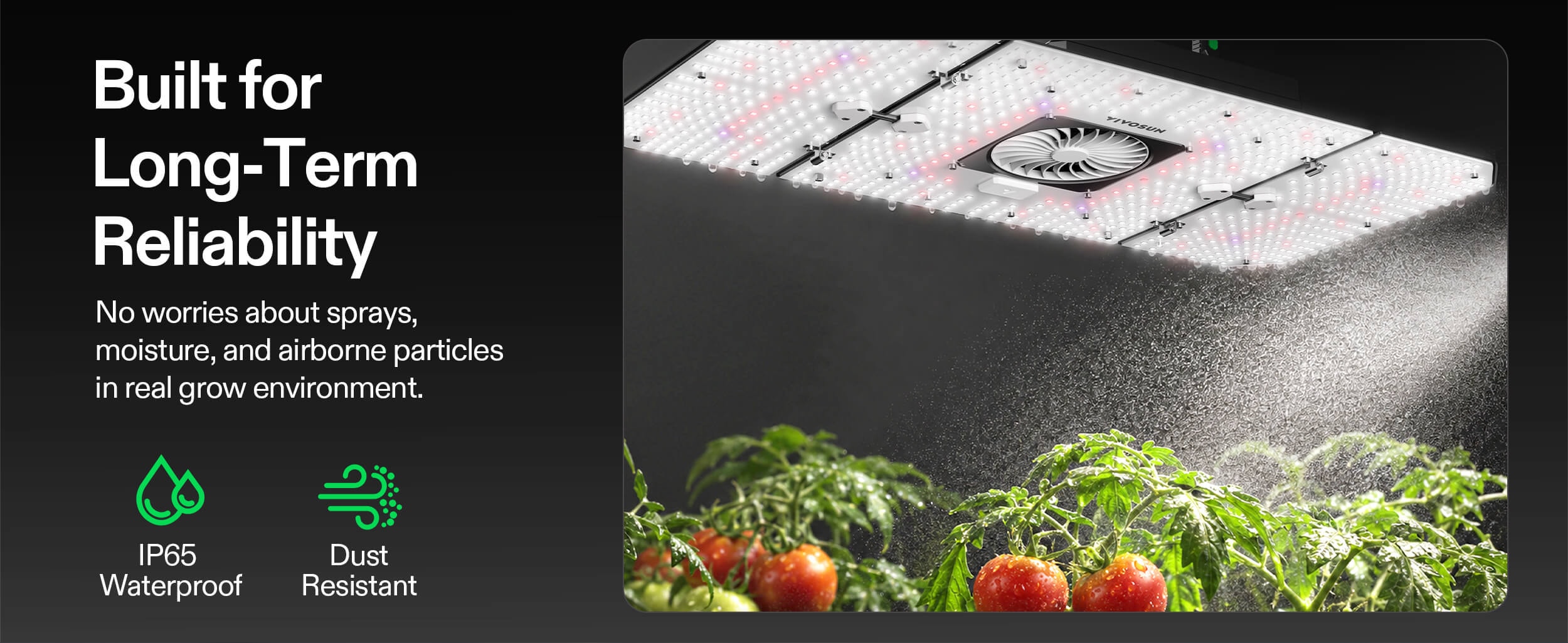
But IP65 is not submersible, and a few rules still apply:
- Keep the driver and connectors dry. Even on an IP65 fixture, the points where the cord meets the housing and where the driver sits are the most vulnerable. Don't let condensation drip onto them.
- Don't spray the light directly while it's powered on. A damp cloth is enough to clean it.
- Watch for condensation on walls and fixtures. It's a sign ventilation isn't keeping up, and standing moisture eventually finds an electrical connection.
Grow Light Safety During Power Outages
A blackout itself is rarely dangerous to your plants. Most photoperiod plants shrug off a missed light cycle — or even a couple of dark days — far better than growers expect. What hurts is the recovery, and the risks are all in how the room comes back:
- The surge when power returns. Power restoration can sometimes produce voltage transients or fluctuations that stress sensitive electronics. A properly rated surge protective device can help reduce the risk.
- The partial outage. This is the genuinely dangerous one: the lights stay on while the exhaust fan dies, so the tent climbs in temperature with nothing removing the heat. If lights and fans are on separate circuits, a fault on one circuit is less likely to shut down both systems at once, but you still need monitoring or a controller that can detect equipment failures.
- The timer reset. A mechanical timer that lost power comes back wrong — lights on during the dark period stresses photoperiod plants. Check the schedule after any outage.
- The unattended restart. If you're not home when power returns, the room should come back to its programmed state, not whatever a dead timer happens to do.
That last point is the strongest argument for a smart controller. VIVOSUN's GrowHub (E42A+ or E25) manages lights, an integrated circulation fan, and inline fans from one place, with schedules, sunrise/sunset ramping, and remote control through the VIVOSUN app. When power returns, it resumes the schedule you set rather than a random last state — and you can see and override what's happening from your phone instead of driving home to check.
A smart controller won't stop an outage, but it removes most of the ways an outage turns into a problem. Skip the UPS for the lights — one big enough to run a grow light for hours costs more than it's worth. If outages are frequent, a generator sized for the exhaust fan is the better spend, because keeping air moving matters more than keeping light on during a short blackout.
What to Do If a Grow Light Falls
Prevention is mostly about the hardware you hang it with: ratchet rope hangers rated well above the fixture's weight, anchored to something structural — the tent frame poles or a solid ceiling point — never a suction cup or a lightweight shelf. Check the clips periodically, because vibration and humidity loosen things over time. Lighter bar-style fixtures spread weight across a wider footprint and do less damage if they do come down.
If a light falls on your plants, in order:
- Unplug it before touching it. Don't reach for a light that's still connected to power, especially if it landed in damp foliage or a tray of water.
- Inspect the fixture and cord before restarting. Look for cracks in the housing, a damaged cord, exposed wire at the connector, or a bent heat sink. A light that took a hard fall and now has a compromised seal or a pinched wire is the classic "worked fine before, doesn't now" hazard.
- Check the plants. Brief contact from a cool, off LED board does surprisingly little. The real injury is a light that stays on resting against leaves — direct contact with even a warm board burns foliage. That's the pattern in the "light fell on my plant" threads: plants usually recover from a single brief contact, but burns from sustained contact take longer to grow out. Lift the light off, remove crushed or burnt leaves, and let it recover on its normal cycle.
- Fix the hang, not just the symptom. If the light fell, re-hang it properly before running it unattended. A light that fell once will fall again if nothing changed.
How Hot Do LED Grow Lights Get?
Warm, not hot. The heat sink will feel warm to the touch — that's the design working as intended. Because most of the electricity becomes heat rather than light, a grow light is effectively a small space heater with a light attached, and the room has to shed that heat. That's why ventilation and driver placement matter as much as the fixture itself.
A light that's hot enough to burn you, or a driver that's uncomfortable to hold, is a problem, not normal operation.
Can You Leave an LED Grow Light On for 18 Hours?
Yes — that's what it's designed for. LED grow lights are built for continuous daily operation over a service life measured in tens of thousands of hours, and 18-hour photoperiods are routine.
The hours only become a risk when the fixture, circuit, or environment isn't up to it: a cheap driver degrades under months of 18-hour days, a near-capacity circuit gets hot under a continuous load, and an unventilated room gets hotter every hour the light is on. Handle those three and the answer is an easy yes.
The modern way to run an 18-hour schedule is to hand it to a smart controller with day/night scheduling. The fewer things that depend on you remembering to flip a switch, the fewer ways a long unattended run drifts into trouble.
Warning Signs: When to Shut It Down
Most of these are early warnings rather than emergencies — but none of them are "normal," and none of them fix themselves.
| Condition | Normal? | What to do |
|---|---|---|
| Heat sink feels warm | Usually normal | Ensure airflow |
| Driver runs warm | Usually normal | Keep ventilated |
| Slight temperature increase in tent | Normal | Adjust ventilation |
| Flickering | No | Turn off and inspect |
| Burning smell | No | Shut down immediately |
| Scorched outlet | No | Stop using circuit |
| Damaged cable | No | Replace/repair |
| Water/condensation on electrical connections | No | Disconnect power safely |
Grow Light Safety Checklist
- Buy a light with a named driver, a real heat sink, and UL/ETL certification — not just a wattage number.
- Mount with ratchet hangers rated above the fixture weight, anchored to structure.
- Plug into a surge protector on a circuit below roughly 80% of its capacity.
- Vent — an exhaust fan and air movement are fire prevention, not just plant care.
- Keep the driver and connectors dry, and treat IP65 as humidity-and-splash-safe, not submersible.
- Check the schedule and the surge protector after any power outage.
- React to flickering, hot drivers, and warm outlets — they're warnings, not quirks.
Frequently Asked Questions
Can LED grow lights catch fire? Yes, but fires trace to the driver, wiring, circuit, or heat buildup — not the diodes. The single most useful thing to scrutinize before buying is the driver: if a listing doesn't name it, treat that as a red flag.
Are grow lights waterproof? Look for IP65 for a grow tent. IP67 provides a higher level of water-ingress protection than IP65, but the appropriate rating depends on the fixture's installation environment.
Is it safe to leave a grow light on overnight? Yes, provided the fixture is well-built, the room is ventilated, and it's on a surge protector. The risk in leaving any continuous load running overnight is the circuit and the environment, not the clock.
What should I do if a grow light falls on my plants? Unplug first, inspect the fixture and cord for damage, then lift it off and check the foliage. The damage that matters comes from a light that stays on against leaves, not from a single brief contact.
Do grow lights need a surge protector? Yes. A surge protector costs a fraction of the light and is the cheapest defense against the voltage spikes that accompany power restoration — the event most likely to kill a driver.
What IP rating do I need for a grow tent? IP65 can be a useful level of enclosure protection for grow environments where dust and water spray are concerns.
IP ratings per IEC 60529. This guide is general information, not a substitute for a licensed electrician's assessment of your specific wiring. If you see scorching, smell burning, or find a hot outlet, shut off the circuit and get it checked.