Temperature and humidity are linked. Warm air holds more moisture than cold air, so the same amount of water vapor gives a lower RH when the air warms up and a higher RH when it cools down. That is why a tent can feel fine at noon and turn damp at midnight, and why the problems change once cold weather arrives.
This guide covers stage-by-stage targets, VPD, winter climate control, night-time stability, and a quick troubleshooting table.
Ideal Grow Tent Temperature and Humidity by Growth Stage
Use this grow tent temperature and humidity chart as a starting point:
| Growth Stage | Lights On | Lights Off | Relative Humidity | VPD Guide |
|---|---|---|---|---|
| Seedling / Clone | 68–77°F (20–25°C) | 64–72°F (18–22°C) | 65–75% | 0.4–0.8 kPa |
| Vegetative | 71–82°F (22–28°C) | 64–75°F (18–24°C) | 55–70% | 0.8–1.2 kPa |
| Early Flower | 68–79°F (20–26°C) | 64–72°F (18–22°C) | 45–60% | 1.0–1.4 kPa |
| Late Flower | 68–76°F (20–24°C) | 60–68°F (16–20°C) | 40–50% | 1.2–1.6 kPa |
| Drying | 60–68°F (16–20°C) | — | 55–60% | — |
These are general guidelines, not fixed requirements. Target ranges vary by plant species, cultivar, growing medium, lighting, and environmental conditions. Drying is done in the dark, so only one temperature applies.
Why the numbers change by stage
- Seedlings and clones have small root systems and lose water through their leaves faster than they can take it up. Higher humidity keeps them from drying out.
- Vegetative plants grow fast and tolerate more heat. Lowering RH gradually as the canopy fills in helps prepare them for flower.
- Flowering plants develop dense growth where moisture gets trapped. Lower humidity and slightly cooler nights reduce the risk of mold and bud rot.
Three habits that make the chart work
- Measure at canopy level, not at the floor or the top of the tent.
- Keep the day/night difference moderate. A moderate temperature drop at night is common, but avoid large or rapid swings. The appropriate night temperature depends on the plant and growth stage.
- Change settings gradually when moving between stages.
What Is VPD?
Vapor Pressure Deficit (VPD) describes the difference between the amount of moisture currently in the air and how much moisture the air could hold at a given temperature.
Temperature and relative humidity should be considered together rather than independently. VPD gives you one more way to judge whether the environment is too humid or too dry for a specific growth stage. Low VPD means the air is very humid and plants transpire slowly. High VPD means the air is dry and plants lose water quickly.
Think of it this way: temperature and humidity are your basic controls, and VPD is the fine-tuning. If your temperature and RH are in range for the stage, your VPD will usually be close to the target.
For more precise control, growers can use leaf temperature and leaf VPD instead of relying on room temperature and RH alone. Leaf temperature can differ from ambient air temperature, so growers seeking more precise VPD control can use an infrared thermometer to measure leaf temperature directly.
How to Keep a Grow Tent Warm in Winter
Why is my grow tent so cold in winter? Usually it's a combination of a cold room, cold surfaces, and an exhaust fan that keeps pulling cold air in. Here is what helps most.
1. Run your lights during the colder part of the day.
Grow lights give off heat. If your room is coldest overnight, shift the light schedule so the lights-on period covers those hours. Keep the photoperiod the same length, avoid light leaks during the dark period, and change the schedule once rather than back and forth.
2. Reduce excess exhaust when the lights are off.
Exhaust removes warm air and pulls cold air in. In winter, avoid running your exhaust fan at unnecessarily high speeds when the lights are off. Use temperature and humidity readings to adjust airflow while maintaining adequate fresh-air exchange. A fan controller with separate day and night speeds makes this easy. See our guide on How Often Should You Run Grow Tent Ventilation?
3. Keep the tent away from cold surfaces.
Avoid exterior walls, windows, cold concrete floors, unheated garages, and uninsulated basements. Raise the tent off the floor on a pallet or foam board, and draw intake air from a heated room when you can.
- Use a heater carefully. A small heater for your grow tent can solve a cold room, but it needs to be used safely. Use a thermostat-controlled heater and keep it away from fabric, plants, water, and electrical equipment. Heating the room around the tent is often safer than placing a heater inside it. For seedlings and clones, a heat mat under the tray warms the root zone.
Also check that your lights are at the right height, since distance affects both heat and light intensity. See How Far Should Grow Lights Be From Plants?
Why Is My Grow Tent Humidity So Low in Winter?
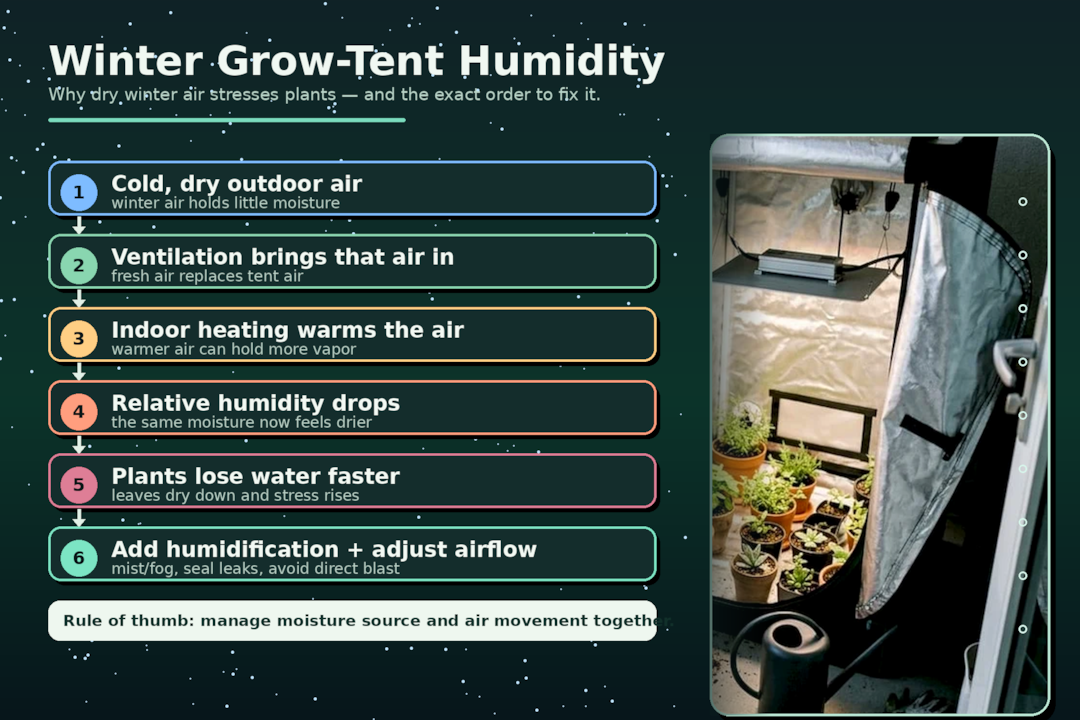
Low humidity is one of the most common winter complaints, and it has a clear chain of cause and effect:
Cold, dry outdoor air
        ↓
Ventilation brings that air into the tent
        ↓
Indoor heating warms the air
        ↓
Relative humidity drops
        ↓
Plants lose water faster
        ↓
Add humidification and adjust airflow
How Winter Affects Grow Tent Humidity
Cold air holds very little moisture. When that air is pulled into a warm tent and heated, its RH falls sharply. Indoor heating dries the room further, so your intake air can start out drier than usual before it even reaches the tent. Plants in low humidity lose water faster than their roots can replace it, which shows up as curling leaves and slower growth, especially in seedlings and clones.
How Ventilation Affects Humidity
Every time the exhaust fan runs, it replaces humid tent air with drier room air. This is essential for fresh CO₂ and heat control, but in winter it can drive RH too low. To fix it:
- Lower fan speed when the lights are off or when temperature allows
- Use a controller so the fan reacts to real readings instead of a fixed speed
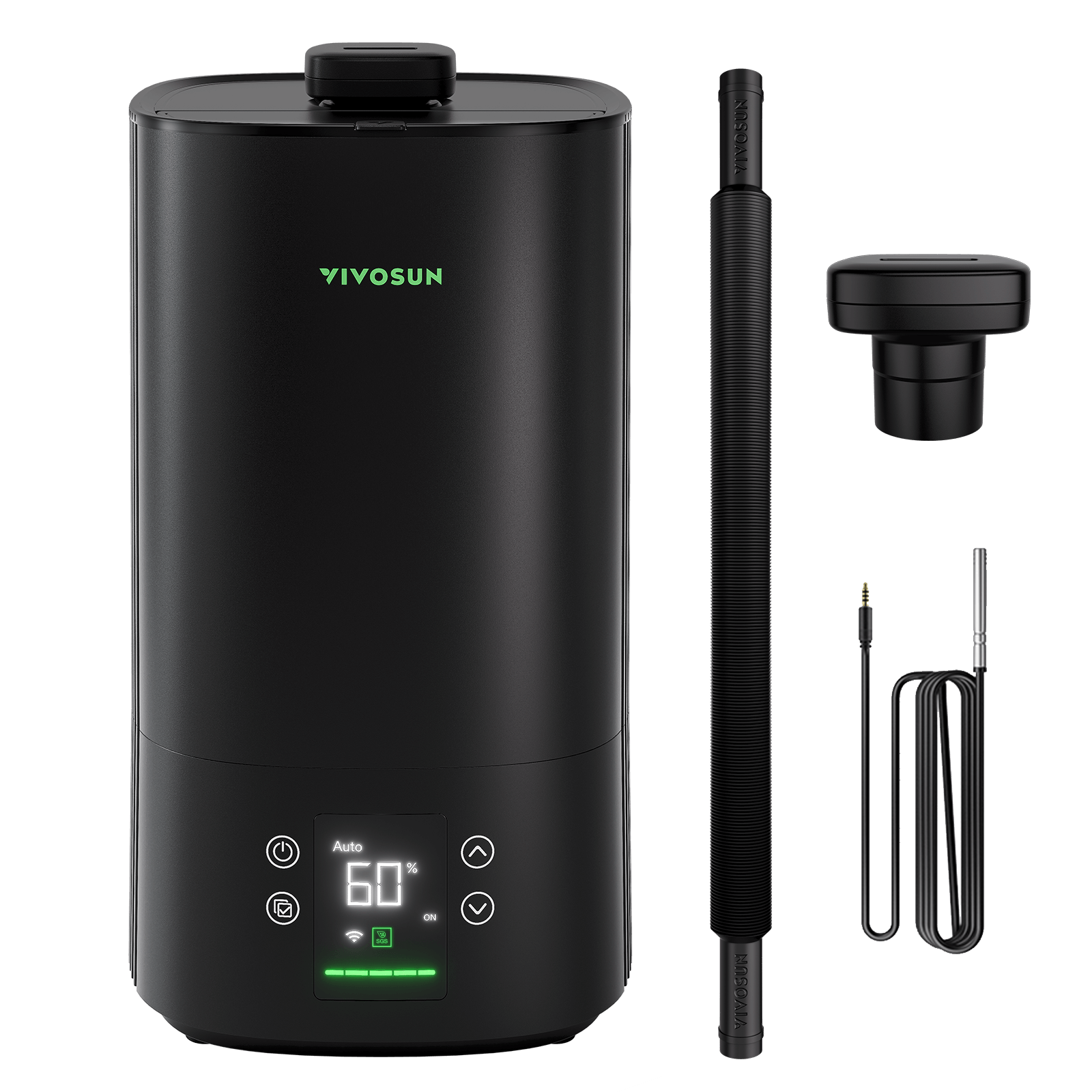
- Add a humidifier, ideally on a controller or smart plug so it holds a target RH
- Keep the tent closed and the door sealed properly
Aim to correct low humidity by matching the stage targets in the chart above, not by chasing the highest possible number.
How to Maintain Temperature and Humidity at Night
Night is when most winter problems appear. With the lights off, the tent loses its heat source, temperatures fall, and RH rises because cooler air holds less moisture. At night, temperatures usually fall while moisture continues to enter the air from plants, growing media, and other sources. Because cooler air holds less moisture, relative humidity can rise quickly when the lights turn off.
- Set separate night targets using the "Lights Off" column in the chart.
- Keep gentle air movement with a circulation fan so moisture doesn't settle on leaves and buds.
- Use a thermostat-controlled heater if the room drops below your night range.
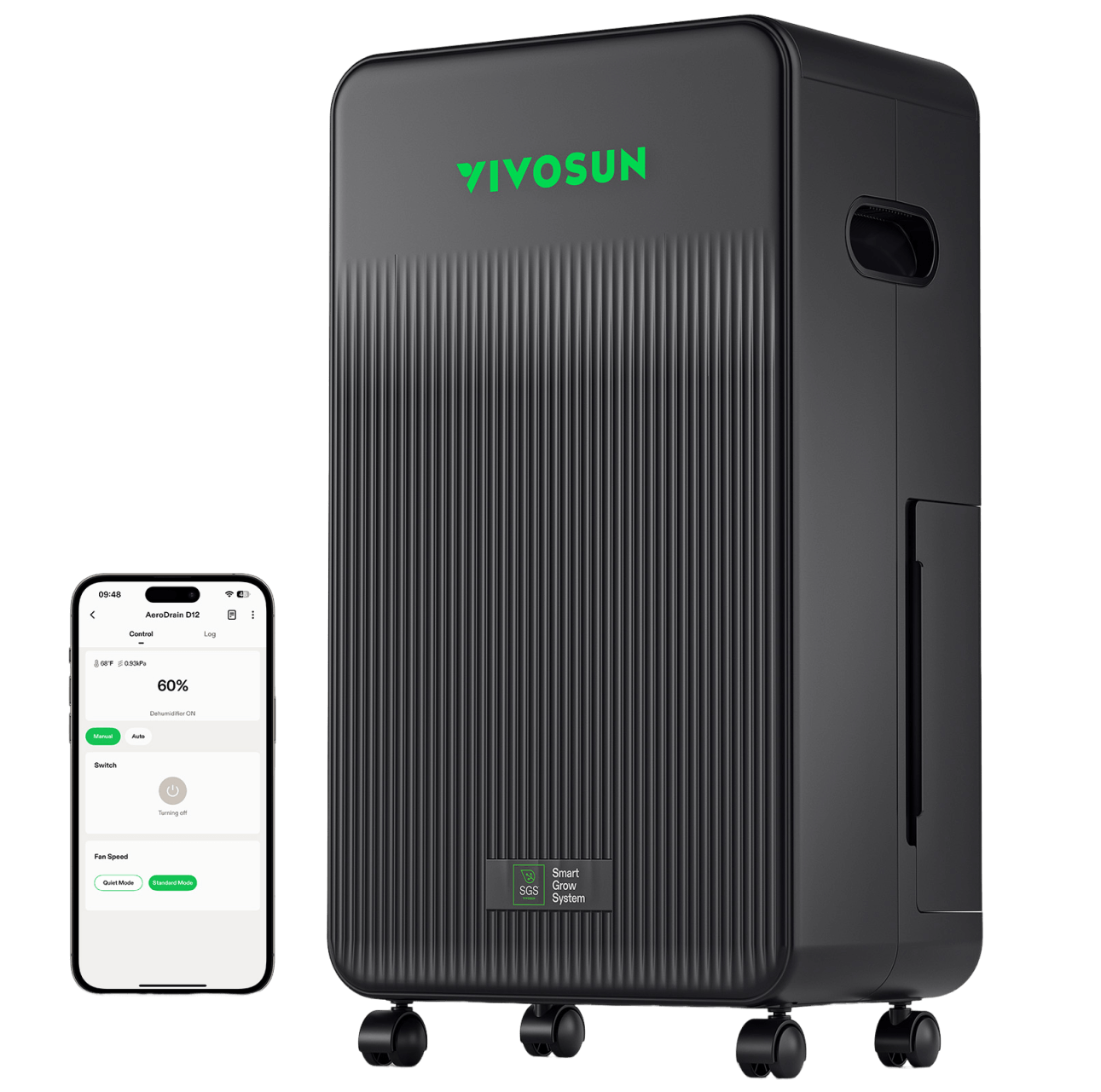
- Use a dehumidifier during lights-off in flower if RH climbs above target.
- Avoid over-venting in a way that pulls in cold air, but don't shut air exchange off completely.
- Automate it. A controller can switch day and night settings for you.
How to Monitor Temperature and Humidity in a Grow Tent
You can't control what you can't see, so good monitoring is the foundation.
- Use a digital thermometer/hygrometer with min/max memory so you can see what happened overnight, not just right now.
- Place the sensor at canopy height, away from the light, the exhaust outlet, and the humidifier's mist.
- Use more than one sensor in larger tents to catch hot spots and damp corners.
- Check both cycles. Read your numbers with the lights on and off.
- Consider a leaf-temperature reading with an infrared thermometer if you're tracking VPD.
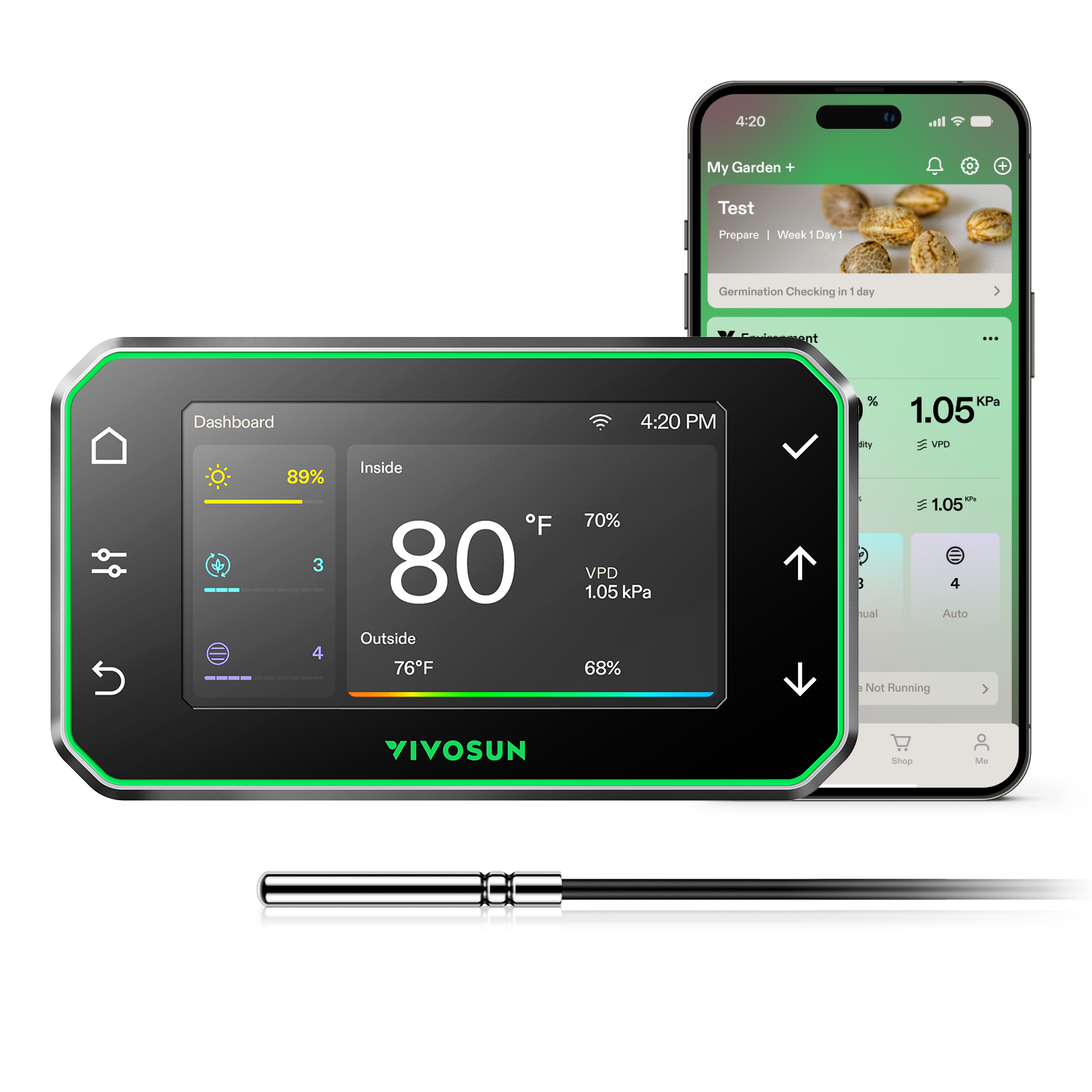
- Automate when ready. A climate controller such as VIVOSUN GrowHub can adjust fans and other equipment from your target temperature, humidity, or VPD. See VIVOSUN Controllers and Temperature & Humidity products.
Common Temperature and Humidity Problems
| Problem | Possible Cause | What to Do |
|---|---|---|
| Grow tent too cold | Cold room, excessive exhaust, insufficient heating | Raise room temperature, adjust exhaust, add controlled heating |
| Grow tent too hot | Grow lights, poor ventilation, warm intake air | Increase airflow, adjust light output, improve exhaust |
| Humidity too low | Dry winter air, excessive ventilation | Use a humidifier, reduce unnecessary exhaust |
| Humidity too high | Overwatering, poor airflow, heavy transpiration | Improve ventilation, use a dehumidifier, reduce standing water |
| Large day/night temperature swings | Unstable room temperature or fan settings | Use a controller and stabilize day/night settings |
Grow Tent Too Cold
Growth slows, and cold combined with high humidity invites mold. Check for cold surfaces, cut back on night-time exhaust, and add a thermostat-controlled heater or heat mat. Also confirm the room itself is warm enough, since it's the easiest fix.
Grow Tent Too Hot
Heat stress shows up as leaf curl, drooping, and stunted growth. Increase exhaust speed, check that intake air isn't warm, dim the lights or raise them, and make sure the inline fan is sized correctly for the tent. See How Far Should Grow Lights Be From Plants?
Grow Tent Humidity Too High
Watch for damp air, condensation, and mold. Remove standing water, avoid overwatering, thin out crowded foliage, add circulation, and use a dehumidifier if ventilation alone doesn't bring RH down.
Grow Tent Humidity Too Low
Symptoms include curling leaves and fast drying of the growing medium. Add a humidifier, reduce unnecessary exhaust, and check your intake air. Water pans and wet towels have only a small effect and can encourage mold, so treat them as a stopgap. Related guide: How to Increase Humidity in a Grow Tent
Large Temperature Swings Between Day and Night
If the tent heats up quickly with the lights on and drops fast when they turn off, the setup is likely reacting to the room rather than being controlled. Stabilize the room, use a controller for day/night fan settings, and add a small thermostat-controlled heater for the lights-off period.
FAQ
What is the ideal temperature for a grow tent?
For most plants, 68–82°F (20–28°C) with the lights on, depending on the stage. Seedlings prefer the lower-middle of that range, vegetative plants tolerate the upper end, and late flower does best at 68–76°F.
What humidity should my grow tent be?
It depends on stage: 65–75% for seedlings and clones, 55–70% in veg, 45–60% in early flower, and 40–50% in late flower. Lower humidity later in the cycle reduces mold risk.
How do I keep my grow tent warm in winter?
Run lights during the coldest hours, reduce exhaust when the lights are off, keep the tent off cold floors and exterior walls, and use a thermostat-controlled heater or heat mat where needed. Insulating the space around the tent also helps.
Is 30°C too hot for a grow tent?
30°C (86°F) is above the ideal range for most stages. It can be tolerated briefly in veg with strong airflow, but sustained heat in flower can stress plants and reduce quality. Aim to bring it down through better ventilation, dimming, or a greater light distance.
What temperature should a grow tent be at night?
Roughly 64–75°F (18–24°C), depending on stage, and about 5–10°F cooler than daytime. In late flower, 60–68°F is a good target.
What is the ideal VPD for a grow tent?
As a general guide: 0.4–0.8 kPa for seedlings, 0.8–1.2 kPa in veg, 1.0–1.4 kPa in early flower, and 1.2–1.6 kPa in late flower. Treat these as targets to fine-tune, not strict rules.
How do I increase humidity in a grow tent?
Use a humidifier on a controller, reduce unnecessary exhaust, keep the tent well sealed, and make sure intake air isn't extremely dry. Aim for your stage's RH target rather than the maximum.
How do I lower humidity in a grow tent?
Increase ventilation, add circulation fans, avoid overwatering, remove standing water, thin dense foliage, and use a dehumidifier if needed.
Why is my grow tent so cold at night?
The lights, your main heat source, are off, and cold air may still be drawn in by the exhaust. Reduce night-time exhaust, keep the tent away from cold surfaces, and add a thermostat-controlled heater if necessary.
Why is my grow tent humidity so low?
In winter, cold outdoor air is very dry, and heating the air lowers its RH further. Ventilation brings that dry air into the tent. Add humidification and lower fan speed where your temperature allows.